

TLDR
A landlord EICR (Electrical Installation Condition Report) for a typical Liverpool two or three bed costs £140 to £220 plus VAT and is valid for five years. You must give a copy to the tenant within 28 days, to the local authority within 7 days of any request, and any C1, C2 or FI defect has to be put right within 28 days. Maximum penalty for non-compliance is £30,000 per breach.
This guide covers Liverpool prices, the codes the report uses, what an unsatisfactory result actually means for your remedial bill, and the bits of selective licensing nobody mentions until the council asks. Around an 8 minute read.
A new tenancy in Anfield starts on the 28th, the inspection report came back unsatisfactory yesterday, and nobody on the report has quoted you for the remedial work. The selective licensing officer has just emailed asking for the certificate. If you’ve been a Liverpool landlord for more than a year or two, that scenario will look familiar.
Three things make landlord EICRs harder than they need to be in Liverpool. Selective licensing is now in force across most of the city, so the council asks for evidence on a rolling basis, not just at renewal. Most of the rental stock is pre-1970s terrace, semi or HMO conversion, which means mixed legacy wiring and old fuse boxes. And the gap between the EICR fee and the remedial fee can be ten times or more, which most contractors don’t tell you up front.
This guide answers the four questions Liverpool landlords actually search for: how much, how often, what the codes mean, and what happens when the report fails.
What a landlord EICR costs in Liverpool right now
For a typical Liverpool rental in 2026, expect to pay £140 to £220 plus VAT for the inspection itself. That assumes a single-let property with one consumer unit and reasonable access. The longer-standing £150 to £300 figure quoted on national landlord-questions pages is reasonable as a UK average but doesn’t sit well with current Liverpool labour rates or the size of the typical Merseyside property book.
Three things move the price:
- Number of circuits. A 1980s three bed with a single 6-way board is fast. A converted Georgian semi in L8 with two boards, a sub-main to a basement flat, and a third board in the eaves takes twice as long.
- Property type. HMO inspections are a separate category. They take longer because every bedroom is a separate inspection point and the local authority will check the certificate against the licensing schedule.
- Access. Tenanted properties with poor access to a board or to under-floor cabling extend the survey. We allow for this in writing rather than mid-job.
For a five bed HMO in L7 Edge Hill with a separate distribution board on each floor, expect £280 to £420 plus VAT. For a single retail unit on Smithdown Road or a small office, allow £200 to £350 plus VAT depending on the number of distribution boards. None of these figures includes any remedial work, which is quoted separately after the inspection report identifies what needs putting right. We’ve broken these bands down further by property type in our EICR cost guide for Liverpool.
The legal framework: 5 years, 28 days, 7 days, £30,000
Under the Electrical Safety Standards in the Private Rented Sector (England) Regulations 2020, every private landlord in Liverpool must hold a satisfactory EICR for each let property. The numbers that matter, all set out in the official gov.uk guidance for landlords, tenants and local authorities, are these.
- Inspection cycle. Every five years, or sooner if the report sets a shorter interval. A change of tenancy doesn’t automatically reset the clock if the existing certificate is still in date.
- Copy to a new tenant. Before they move in. Not on the day; before. This is the same window as the gas safety certificate.
- Copy to existing tenants. Within 28 days of the inspection.
- Copy to the local authority on request. Within 7 days. Liverpool City Council will ask, and the email goes out from the licensing team rather than the housing team, so it can land in a different inbox to your usual landlord correspondence.
- Remedial work after an unsatisfactory result. Within 28 days, or sooner if the report specifies it (a C1 typically gets isolated on the day of the inspection).
- Maximum penalty. £30,000 per breach. Liverpool City Council enforces this directly and has issued penalty notices in the city in the last two years.
The 28 day remedial window is the one that catches landlords out. If your inspection day is the 1st of the month and the report comes back unsatisfactory, the remedial work has to be complete and a fresh satisfactory report issued by the 29th. That means booking the remedial scope inside the first week.

C1, C2, C3 and FI: what your report actually means
Every defect on an EICR is given one of four codes. The first three of these decide whether the report is satisfactory. The fourth, FI, decides whether more work is needed before the inspector can sign it off either way.
- C1, danger present. Immediate risk of injury. The inspector will normally isolate the affected circuit on the day. Examples: exposed live conductors, broken socket faceplate with bare copper visible, missing earth bonding to a metal gas pipe.
- C2, potentially dangerous. Urgent remedial action required. No immediate isolation but the report is unsatisfactory until it’s fixed. Examples: a damaged consumer unit cover, RCD that fails its trip test, an undersized main earth conductor.
- C3, improvement recommended. Doesn’t make the report unsatisfactory. The installation is safe but doesn’t meet the current edition of BS 7671. Examples: lack of RCD protection on a circuit installed before this was required, no surge protection device on the main board.
- FI, further investigation required. The inspector found a symptom they couldn’t trace to a cause within the inspection time. Treats the report as unsatisfactory until the FI is closed out, usually by a follow-up visit.
A satisfactory report has zero C1, C2 and FI items. Any combination of those three flips the report to unsatisfactory and starts the 28 day remedial clock. C3 items don’t fail the report but they’re worth scoping at quote stage, because they’re often cheap to put right at the same time as a C2 fix and they reduce the C2 risk on the next inspection. There’s a deeper walk-through with examples in our EICR codes explained guide.
If you’ve been told your installation has “failed”, ask the contractor to read out the C1, C2 and FI items specifically. Anything they describe as “code 3, but I’d recommend doing it” is a C3 and isn’t part of the legal remedial requirement.
What happens after a failed EICR: remedial, partial rewire, or full rewire
This is the part of the process that nobody explains in a quote. An unsatisfactory EICR puts you on a fork in the road, and the right answer depends on what the report actually contains.
- Single C2 on a known fault. Often a discrete remedial. Replacing a damaged consumer unit, fitting a missing RCD, re-bonding a metal pipe. Typical cost £180 to £450 plus parts. The contractor reissues the EICR as satisfactory once the work is done and tested.
- Multiple C2s spread across the installation. Often a partial rewire. The kitchen and bathroom circuits, the consumer unit, and any external sockets get pulled and replaced with current spec. The rest of the cable is left in place if it tests clean. Typical cost £1,800 to £3,500 plus VAT depending on access.
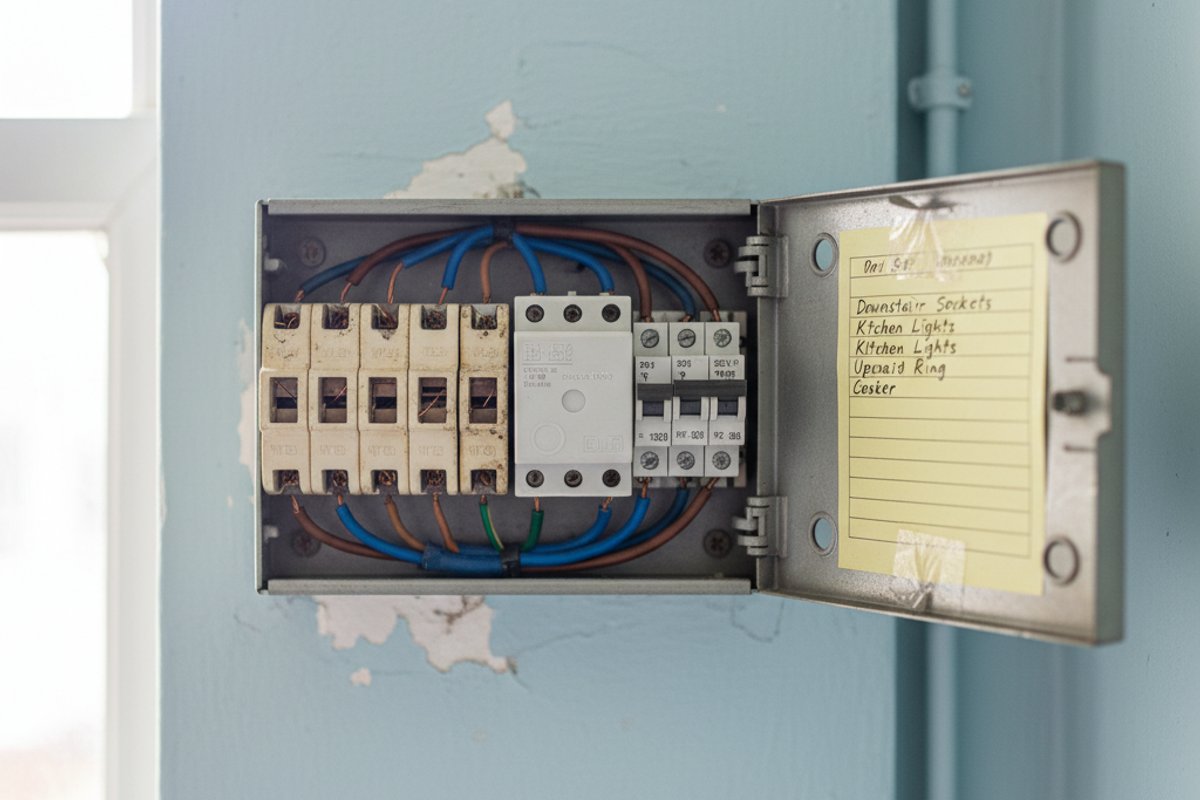
- Pre-1970s rubber or paper-insulated cable, multiple C2s, an old wooden-back board. Usually a full rewire. The cable insulation is the issue, not the fittings, so a partial rewire only buys a few years and the next EICR fails on the same items. Typical cost £3,200 to £6,500 plus VAT for a 2-3 bed terrace.
The honest version of this conversation is that a partial rewire on rubber cable is rarely the right call. It looks cheaper in week one and costs more across the next inspection cycle. We’ll always quote both partial and full where it’s a borderline case, and we’ll write down what the partial doesn’t bring up to the current edition of BS 7671 so you can make the call with the data.
If your EICR has come back unsatisfactory and you need a remedial quote against the specific items, ask the contractor to itemise the C1, C2 and FI scope and to quote both the remedial-only fix and any larger rewire option that the cable condition would justify.
Liverpool selective licensing and HMO obligations
Liverpool City Council operates Selective Licensing across most of the city. If your property sits in Anfield, Everton, Kensington, Picton, Princes Park, Tuebrook, Stoneycroft or Wavertree, you’re in a designated zone and the council can ask for your EICR at any point in the licence period, not just at renewal.
HMOs are a tighter regime again. Mandatory HMO licences (5 or more occupants forming more than one household) carry their own electrical condition requirements, and most Liverpool HMO conditions specify an EICR every five years as a minimum, with annual visual inspections in between. The council can shorten that cycle as a condition of the individual licence, so it’s worth reading your schedule. The licensing crossover, the HMO-specific items inspectors check, and the visit logistics are covered in detail in our guide to EICR for Liverpool HMOs.
What this means in practice: keep the certificate, the schedule of test results, and the contractor’s registration number filed where you can email them within an hour. The 7 day window for council requests is a calendar week, not 7 working days. A request received on a Friday afternoon expires on the following Friday.
Tenant access and scheduling around in-situ tenants
Most Liverpool landlord EICRs are run with the tenant in residence. The inspection itself is around two hours for a typical two or three bed. Power needs to be off for 30 to 60 minutes of that. We’ll always agree the access window with the tenant in writing before the visit, and we’ll work around shift patterns where the property has shift workers in it.
If a tenant refuses access, the regulations don’t penalise a landlord who has made reasonable attempts and documented them. What the council and any later First-tier Tribunal will look at is the paper trail: written notice, the dates you offered, the tenant’s response, and the dates you escalated the request. We can supply a written record of any visits we attempted but couldn’t carry out, which sits in the same file as the certificate.
For larger remedial work, void periods are easier and cheaper, because we can isolate the property and run consecutive days. Where the tenant is staying in residence, we’ll work on a single floor or a single circuit at a time and we’ll sequence so the kitchen and bathroom are off the shortest amount of time.
A note on EIC vs EICR
This catches landlords out a lot, and a clean answer saves a phone call. An EIC (Electrical Installation Certificate) is issued after new work, for example a new consumer unit fit. An EICR is a periodic condition report on the existing installation. They are not the same thing, and an EIC for a fuse box swap last year does not satisfy the 5 year EICR requirement on the rest of the installation.
Where an EIC was issued for a recent full rewire, the EICR clock starts from the date of that EIC. Where the EIC was for a part of the installation (a board change, a kitchen circuit), the EICR is still required for the rest of the wiring on the original 5 year cycle.
If you’re unsure which certificate you have, look at the document title. EIC certificates have “Electrical Installation Certificate” at the top. EICR reports have “Electrical Installation Condition Report” and a schedule of test results with codes against each circuit. Both, along with MEIWC and Part P, sit on our electrical certificates page if you’d like to see what each one looks like.
Why Maximec
NICEIC-registered, Platinum Promise insurance-backed for six years on the installation. Independently assessed every year and audited against the latest BS 7671. Michael, the founder, runs most of the landlord EICR remedial and commercial work in person.
Based in Rainhill, we cover Liverpool and the wider North West, including Toxteth, Kensington, Anfield, Walton, the Wirral, St Helens, Widnes, Runcorn and Warrington.
Choosing a contractor for the inspection
The qualified-person test in the regulations is competence, not just registration. Practically, that means a current member of a competent person scheme (NICEIC, NAPIT or SELECT in Scotland), insurance documentation you can see, and an EICR template that matches the IET model form. Anything that pulls the schedule of test results off a one-page tick-list isn’t a valid EICR.
The documentation pack the council and most letting agents will accept covers four items: the registration number, the public liability and indemnity certificates, the IET-format report, and the schedule of test results signed by the inspecting electrician. Anything thinner than that is a certificate that won’t survive a licensing query.
Frequently Asked Questions
How much does a landlord EICR cost in Liverpool in 2026?
£140 to £220 plus VAT for a typical single-let two or three bed in 2026. HMOs run £280 to £420 plus VAT depending on the number of distribution boards and bedrooms. Commercial premises start at £200 plus VAT and go up with circuit count. None of those figures includes remedial work, which is quoted separately once the inspection report identifies what needs putting right.
How often does a Liverpool landlord need an EICR?
Every five years, or sooner if the report sets a shorter interval. A change of tenancy doesn’t reset the clock if the existing certificate is still in date and was issued for the whole installation. HMO licence conditions can require shorter cycles, so check your individual licence schedule.
What does C1, C2, C3 mean on my EICR?
C1 is “danger present”, a live risk that the inspector will usually isolate on the day. C2 is “potentially dangerous”, urgent remedial work required. C3 is “improvement recommended”, safe but below current standards and not a fail. Any C1 or C2 (or an FI, further investigation required) makes the report unsatisfactory and starts the 28 day remedial clock.
What’s the penalty if I don’t have a current EICR for my Liverpool rental?
Up to £30,000 per breach. Liverpool City Council enforces directly and has issued penalty notices in the city in the last two years. The council can request the certificate at any point during a selective licensing period, not only at renewal, and you have 7 days from the request to supply it.
My EICR was unsatisfactory. What now?
Get a remedial quote written against the specific C1, C2 and FI items, and book the work to complete inside the 28 day window. Ideally use the same contractor who did the inspection, because they re-test and reissue the EICR as satisfactory in a single visit. If the remedial scope is large or the underlying cable is old, ask for a separate full or partial rewire quote alongside the remedial.
Is an EIC the same as an EICR?
No. An EIC (Electrical Installation Certificate) is issued after new work. An EICR (Electrical Installation Condition Report) is a periodic inspection of the existing installation. An EIC for a recent fuse-board swap doesn’t satisfy the EICR requirement on the rest of the wiring; the periodic 5 year cycle still applies.
What if my tenant refuses access for the EICR?
The regulations don’t penalise a landlord who has made reasonable attempts and documented them. Serve written notice, log the dates you offered, log the tenant’s response, and escalate in writing. Keep the paper trail with the certificate file. The council and any later tribunal will look at the documented attempt, not just the missing certificate.
Related Services
Need an EICR before the new tenancy?
Book the inspection and you’ll get a coded EICR back the same or next working day, with any remedial work quoted as a separate scope so you know the full picture before you commit.
NICEIC-registered with Platinum Promise cover. Based in Rainhill; covering Liverpool and the North West. Call 0151 792 3243 or request a free no-obligation quote.