
TLDR
A full house rewire in the UK in 2026 usually costs between £3,500 and £5,500 for a 3-bed semi, rising to £7,000+ on older 4-bed properties, with most jobs taking 5 to 10 working days and finishing with an Electrical Installation Certificate (EIC) and Part P certificate in your file.
This guide covers what the price actually pays for, how to tell a full rewire from a partial, and the questions to ask before you sign the quote. About a 6-minute read.
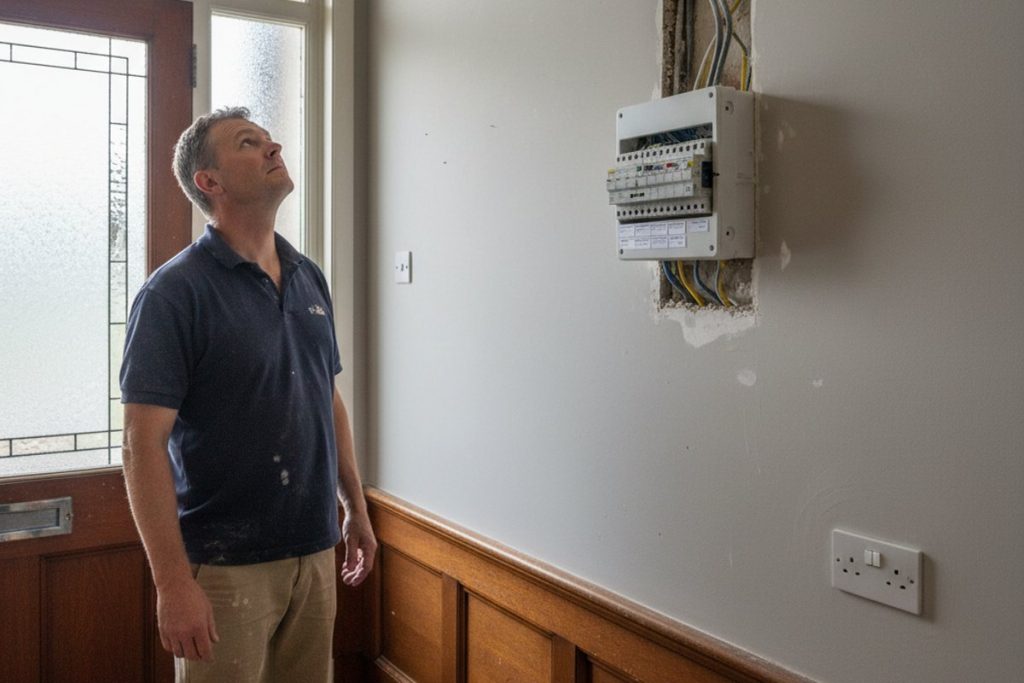
If you’ve just bought an older Liverpool terrace and the survey mentioned “original electrical installation”, or you’re a homeowner whose RCD trips every time the kettle goes on, you are probably weighing a rewire against another year of patching. The honest truth is that rewire quotes vary wildly because every house is different, and the quote that comes back £2,000 lower than the others is usually missing something you’ll pay for later.
What follows is a plain-English breakdown of UK rewire costs in 2026, how long the work takes, what a proper quote should include, and the difference between a partial rewire and the full-house job that properties built before the 1970s almost always need. The numbers below are honest industry ranges, not sales figures. On any specific property the only accurate quote comes after a site survey.
How much does a full house rewire cost in the UK in 2026?
The short version: expect roughly £3,500 to £5,500 for a standard 3-bed semi, £4,500 to £8,000 for a 4-bed detached, and £2,800 to £4,000 for a 2-bed terrace. Partial rewires start around £1,200. These are ex-VAT figures for the electrical work; most trades add 20% VAT on top, and if you need plaster making good beyond a basic patch, that is quoted separately.
- 1-bed flat or maisonette: £1,800 – £2,800
- 2-bed terrace or semi: £2,800 – £4,000
- 3-bed semi or terrace: £3,500 – £5,500
- 4-bed detached: £4,500 – £8,000
- 5-bed or larger period property: £6,500 and up
- Partial rewire (kitchen + bathroom, or a single circuit group): £1,200 – £2,500
- Consumer unit replacement only: £450 – £800
Price bands widen on period properties for good reason. A Victorian terrace in Toxteth or a 1930s semi in Aigburth almost always has at least one circuit with original rubber-insulated cable, extra lath-and-plaster walls that make cable-chasing slower, and no obvious route for runs between floors. That’s 1-2 extra days of labour before anyone has added a socket.
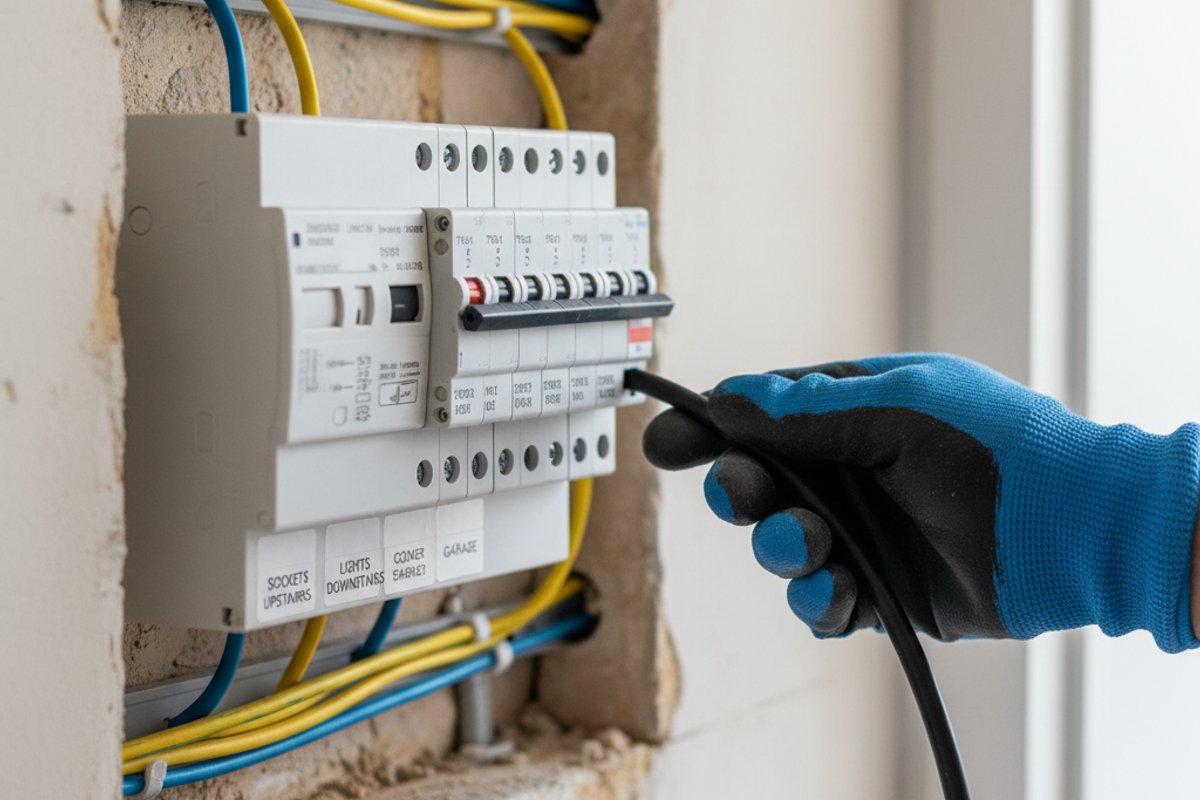
What pushes a quote toward the top of the range: pre-1970s property, spray-foam loft insulation that traps cable runs, solid plaster walls rather than stud, a consumer unit upgrade that also needs main-fuse work with the DNO, and additional circuits (EV charger, electric shower, induction hob) beyond the standard set. What keeps it toward the bottom: open-plan layouts, recent extension with accessible cavities, and a property the electrician can work in without occupants in the rooms.
How long does it take to rewire a house?
For most UK properties: 5 to 10 working days, split into first fix (the rough-in of cable, back-boxes, and the new consumer unit) and second fix (fitting sockets, switches, light pendants, testing, and certification). A 2-bed terrace is usually 3 to 5 days; a 3-bed semi is 5 to 7; a 4-bed detached runs 7 to 10; larger period properties can take two weeks or more.
A typical week on a 3-bed rewire looks like this. Day one and two: lifting carpets and floorboards, chasing walls, running new cable, fitting new back-boxes. Day three: second coat of chasing and first-fix testing. Day four: swapping the consumer unit, commissioning new circuits, and most of the second fix. Day five: fitting accessories, lighting, testing every circuit to BS 7671, issuing the certificate, making good the plaster patches, and a final tidy.
You do not have to move out. Most homeowners stay in the property and move around with the team. The lead electrician will tell you which rooms are live on which days and when the power will be off (usually for a few hours while the consumer unit is swapped).
What’s included in a proper rewire quote?
A written, itemised rewire quote from a NICEIC-registered contractor should cover:
- Full removal of existing wiring, with safe disposal
- New twin-and-earth cable to current BS 7671 18th Edition standard
- A new consumer unit with RCBOs on each circuit and surge protection
- All new back-boxes, sockets, switches, and light pendants (fittings supplied by owner or quoted as extra)
- Smoke and heat alarms on every storey, wired and interconnected
- Testing, inspection, and the Electrical Installation Certificate (EIC)
- Part P notification to Building Control (on a domestic property)
- Basic making-good of chased plaster
What is usually not included and will be quoted separately: re-plastering beyond a basic patch, redecoration, floor finishes, and any structural work needed to access hidden cable routes. If a quote is conspicuously lower than others, check whether the consumer unit, certification, and Part P notification are actually in there. A rewire without a certificate is worth less than the wire it put in, for insurance and resale.
Partial rewire vs full rewire: which do you actually need?
A partial rewire replaces specific circuits (usually the kitchen and bathroom, or whichever section failed an EICR) while leaving the rest of the installation in place. It costs £1,200 to £2,500 and takes 2 to 3 days. A full rewire replaces every circuit in the property and finishes with a whole-installation EIC that insurers and mortgage surveyors recognise without question.
When a partial is genuinely enough: the rest of the installation is modern (2000s onwards), the consumer unit is already an RCD-protected unit, and the circuits you are replacing are isolated problems (a failed kitchen ring, a new bathroom fan circuit). When it is not enough: there is any rubber-insulated cable live in the property, the fuse board is a pre-2000 wylex rewireable type, the EICR came back unsatisfactory across multiple circuits, or you plan to add an EV charger or electric shower that would overload the existing main cable.
On a Liverpool 1930s semi we almost always find that what the homeowner thought was a £1,500 partial turns into a £3,800 full rewire once the floorboards are up. That’s not an upsell, it’s the work the property actually needs. A good electrician will tell you on the first survey if a partial is going to struggle to certify.
Signs your house actually needs rewiring
Clear rewire triggers a UK homeowner can spot without lifting a floorboard:
- Wooden or rubber-insulated cable visible in the loft or under floors. Anything pre-1970 is past its service life and a real fire risk.
- A wylex fuse board with rewirable fuses (the little cards). If you’ve changed a fuse-wire in your life, the consumer unit is overdue.
- Two-pin round sockets or fabric-covered flex still in use anywhere.
- Burning or fishy smells from sockets or switches, even once.
- Sockets that get warm in normal use.
- The main RCD trips repeatedly and nobody’s found the cause.
- An EICR came back unsatisfactory with multiple C1 or C2 codes across circuits.
- The last recorded electrical installation work is more than 25 years old and the property has never had a full test.
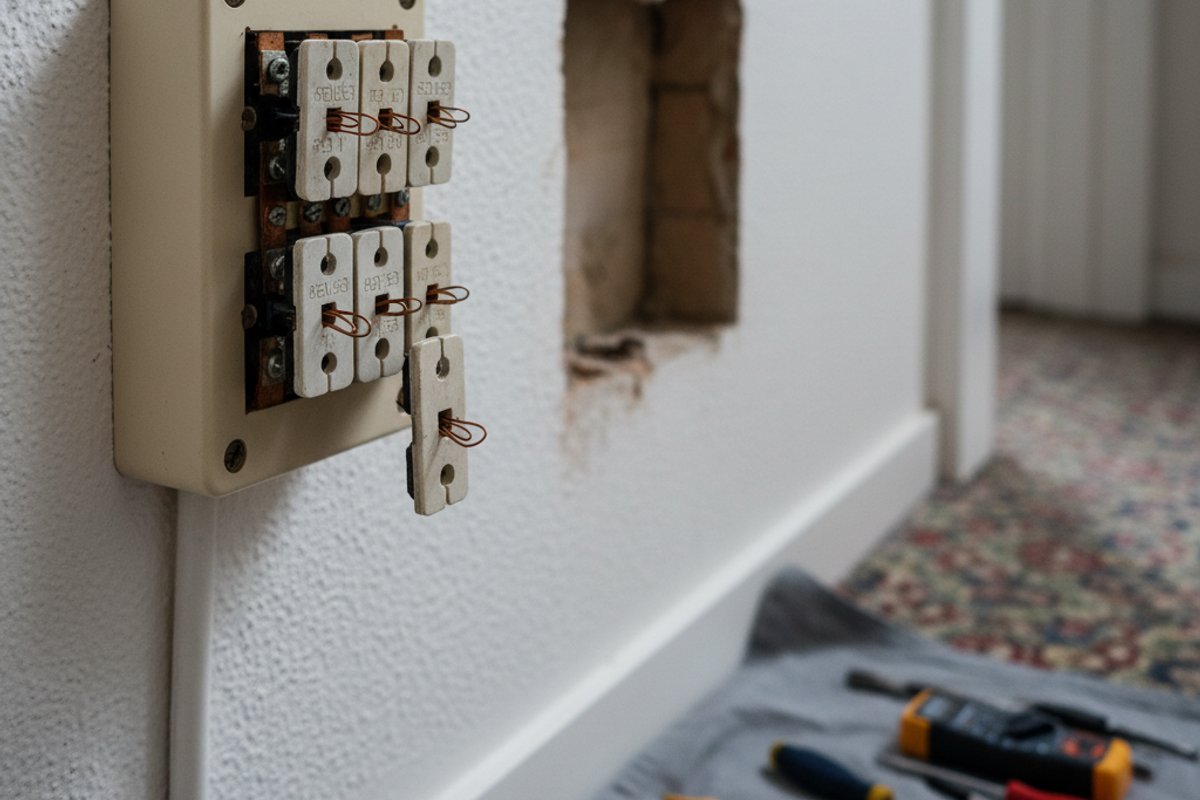
If two or more of these apply and the property was built before 1975, a rewire is almost certainly the answer, not a consumer unit swap. Electrical Safety First, the UK’s consumer-facing electrical safety charity, publishes guidance on when a home needs rewiring; it’s a useful second opinion before you commit to the work.
From a recent job
“Michael fixed the lights then told me the house would need rewiring due to safety. He did not pressure us whatsoever. He told me to get quotes from other companies too. I was so impressed with his honesty and integrity that I told him to do the rewiring. Best thing ever, it was done in a week.”
Joanne Hughes, Homeowner — full house rewireHow to get an accurate rewire quote
A trustworthy rewire quote follows this shape:
- Free site survey, usually 30-45 minutes. The electrician walks the property, lifts a board or two if needed, looks at the consumer unit, and notes the circuits.
- Written itemised quote within a few working days. Labour, materials, consumer unit, accessories, certificate, and making-good all on the same document. VAT shown separately.
- A clear start date and a realistic finish window (not “it’ll be done next week” over the phone).
- Certificate on completion: an EIC for the rewire, plus Part P notification to Building Control lodged within 30 days.
- A stated policy on snagging — most NICEIC-registered firms offer at least 14 days for any callback, often longer if the work is under a Platinum Promise guarantee.
Check the NICEIC register at niceic.com before you book. A quick search against the company name or the lead electrician will confirm whether the contractor is current and what scope of work they are assessed for. If the contractor cannot tell you what certificate you will receive on completion, that is a signal to get another quote.
Frequently Asked Questions
How much does it cost to rewire a 3-bed house in the UK?
For a standard 3-bed semi or terrace in 2026, expect £3,500 to £5,500 ex-VAT. The lower end applies to newer 1990s-and-later properties with accessible cable routes and a recent consumer unit; the upper end applies to pre-1970s properties where floorboards and solid walls slow the work. Add 20% VAT and budget another £300 to £800 for redecoration if you care about paint matching after the plaster patches dry.
Does a 40-year-old house need rewiring?
Not automatically. A property built in the mid-1980s will usually have PVC twin-and-earth cable, which has a service life of 40 to 50 years, and an early-generation consumer unit. It is on the cusp. A periodic inspection (an EICR) will tell you whether the installation is still safe or whether some circuits need upgrading. If the EICR comes back satisfactory you can leave it; if it flags multiple circuits, plan a rewire inside the next 12 to 24 months.
How can I tell if my house needs rewiring?
Look for the external signs first: rewirable fuse board, two-pin sockets, rubber or fabric-covered cable, sockets that get warm, burning smells, or repeated RCD tripping. Any one of those is a reason to get an inspection. The definitive answer comes from an EICR, which tests every circuit and flags issues with coded severity (C1, C2, C3, or FI). An EICR typically costs £120 to £300 depending on property size and comes back within a week.
Is it worth rewiring an old house?
Usually yes, if you plan to stay more than 3-5 years or you are trying to sell. A rewire resets the safety clock for another 25+ years, removes an insurance friction point, and often adds more than its cost to a period property’s asking price because mortgage surveyors no longer flag the electrics. If you are selling within a year and the EICR is satisfactory, a rewire is rarely cost-effective.
Do I need to move out while the work is happening?
No, in almost all cases. The property remains habitable. You will lose power to specific rooms on specific days, and a few hours without any power on the day the consumer unit is swapped. The electrician will give you a room-by-room schedule on day one so you can plan around it. Dust sheets are used on furniture and flooring.
Can I just replace the consumer unit instead of rewiring?
Sometimes, but not if the existing cable is not fit to be connected to a modern consumer unit. Replacing the consumer unit on a property with rubber-insulated cable or failed-insulation circuits fails the installation test and the electrician will refuse to certify it. A CU replacement on its own makes sense only when the existing installation is otherwise sound, usually post-2000 properties with a tired or non-RCD fuse board.
What certificate do I get after a rewire?
An Electrical Installation Certificate (EIC) signed by the registered electrician, plus a Part P notification to your local Building Control (lodged within 30 days of completion). These are the two documents your insurer and any future buyer will ask to see. Keep them with your property deeds.
How often should a house be rewired?
Modern PVC-insulated installations have a service life of 40 to 50 years. That means a 1990s rewire is approaching its replacement window; a 2010s rewire is nowhere near. The rule of thumb: an EICR every 10 years for an owner-occupied home, every 5 years (or new tenancy) for a rental. A satisfactory EICR resets the clock. Repeated unsatisfactory EICRs mean it’s time.
Related Services
Thinking about rewiring your home?
We’ll come and look at the property, work out whether you actually need a full rewire or just a consumer unit upgrade, and send a written itemised quote within a few working days. Free survey, no obligation.
NICEIC-registered and covered by the Platinum Promise. Founder-led — Michael is the lead electrician on the majority of rewire jobs. Based in Rainhill; covering Liverpool and the North West. Call 0151 792 3243 or request a free no-obligation quote.