
TLDR
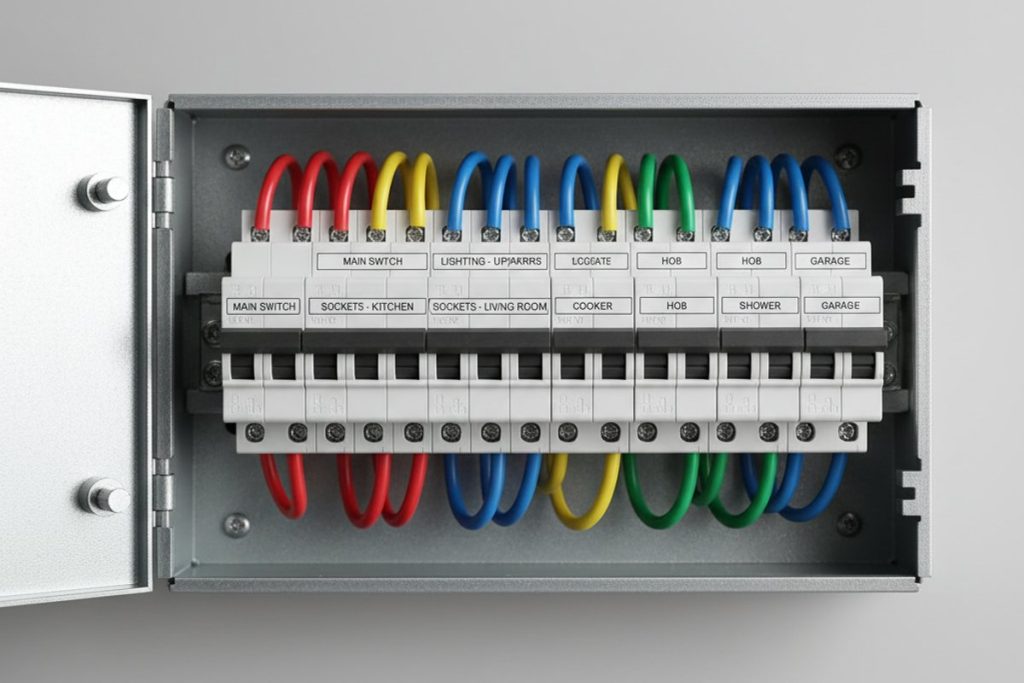
An MCB (Miniature Circuit Breaker) protects the cable from overloads. An RCD (Residual Current Device) protects you from earth faults and electrocution. An RCBO (Residual Current Breaker with Overcurrent protection) does both in a single device. The 18th Edition of BS 7671 now requires new consumer unit installations to use individual RCBOs per circuit rather than one shared RCD for a group of circuits.
This post explains what each device does, why the change to RCBOs matters for Liverpool homeowners, and what a Surge Protection Device (SPD) is, the one component most people have never heard of but which is now also a BS 7671 requirement. About a 6-minute read.
You have been quoted for a new consumer unit, or told your existing board needs replacing, and the electrician’s quote mentions RCBOs, SPDs, and “18th Edition compliant”. If you have no idea what those mean, you are not alone. Most homeowners in Liverpool and Merseyside have lived with the same split-load board for 20 years and never needed to think about what is inside it.
This guide explains the three device types plainly, why the shift to RCBOs represents a genuine improvement in protection, and what the 18th Edition of BS 7671 (the UK Wiring Regulations, updated in 2018 and amended in 2022) actually requires when a new consumer unit is installed.
MCBs: They Protect the Cable, Not You
An MCB (Miniature Circuit Breaker) is the row of individual switches inside your consumer unit, one per circuit. Its job is to protect the cable on that circuit from carrying too much current, the kind of overload that causes cables to heat up and, in older properties, start fires inside the wall.
When the current through a circuit exceeds the MCB’s rated value (typically 6A for a lighting circuit, 16A for a kitchen appliance, 32A for a ring main), the breaker trips and interrupts the supply. This protects the wiring. It does not protect you from an earth fault, a fault where current leaks from a live conductor to earth, which can pass through a person in contact with a faulty appliance or fitting. For that, you need an RCD.
MCBs have effectively replaced the older rewirable fuses that older Liverpool properties still sometimes have, those ceramic or glass fuse carriers with wire that melts when the current exceeds a threshold. The MCB does the same job but trips and resets mechanically rather than requiring a new fuse wire.
RCDs: They Protect You, Not Always Individually
An RCD (Residual Current Device) monitors the balance between current flowing out on the live conductor and returning on the neutral conductor. In a healthy circuit, these are equal. If current is leaking to earth, through a faulty appliance, a damaged cable, or a person in contact with a live part, the balance tips. The RCD detects that imbalance and trips within 40 milliseconds, fast enough to prevent a fatal electric shock under most circumstances.
The older split-load consumer unit, common in Liverpool housing built between 1980 and 2010, has one or two RCDs covering groups of circuits. This arrangement has a well-known weakness: if the RCD protecting the downstairs sockets trips because of a faulty washing machine, it takes out every circuit on that half of the board simultaneously, upstairs sockets, the fridge, the internet router. One fault, multiple rooms affected.
The split-load design was a cost compromise at the time. Individual RCDs per circuit were available but significantly more expensive. That changed with the widespread adoption of RCBOs.
RCBOs: One Device Per Circuit, Full Protection
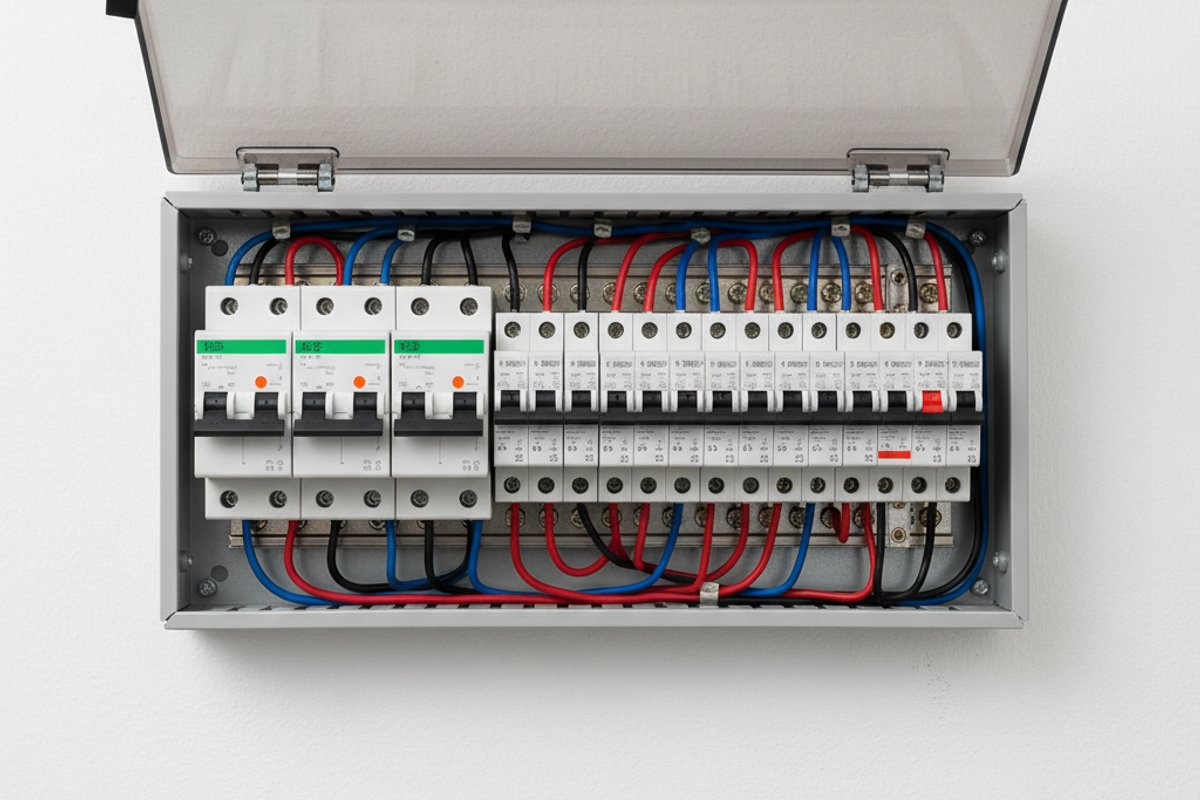
An RCBO (Residual Current Breaker with Overcurrent protection) combines the overcurrent protection of an MCB with the earth-leakage protection of an RCD in a single device, sized for one circuit. In a modern RCBO consumer unit, every circuit has its own RCBO. A trip on the kitchen ring main trips only that circuit, the rest of the board stays live.
From a practical standpoint, this is the consumer unit that should have been standard from the outset. An RCBO board in a Liverpool property means:
- A faulty washing machine trips one breaker, not half the house.
- Fault diagnosis is faster, the tripped RCBO identifies the circuit directly.
- Every circuit has both overcurrent and earth-fault protection, not just those on an RCD protected section.
- Circuits that are not on an RCD in older split-load boards (sometimes the cooker circuit or immersion heater were unprotected) now have full protection.
The 18th Edition of BS 7671:2018 (as amended by Amendment 2, published in 2022) now requires new domestic consumer unit installations to use RCBOs or equivalent individual RCD protection per circuit. A split-load board with a shared RCD is no longer acceptable for new installations, though existing installations are not retroactively required to upgrade purely on that basis.

SPDs: The Device Most Homeowners Have Never Heard of
A Surge Protection Device (SPD) is required under BS 7671:2018 Amendment 2 for new consumer unit installations in most domestic properties. An SPD protects equipment connected to the installation from voltage spikes caused by lightning strikes, grid switching events, and nearby industrial equipment. Those spikes, which can reach thousands of volts for microseconds, do not trip an MCB or RCD but can destroy electronics and sensitive equipment silently.
In practice, an SPD is a relatively compact device fitted inside or adjacent to the consumer unit. It does not interfere with normal operation. Its presence is now a requirement rather than an optional upgrade when a new consumer unit is installed, an electrician fitting a new board without an SPD where one is required would be fitting a non-compliant installation.
The question of whether an SPD is required depends on a risk assessment under BS 7671 Regulation 443.4. In most standard UK domestic properties, the answer is yes. The Part P certificate issued on completion will confirm the installation is compliant with current regulations including the SPD requirement.
What a Modern Consumer Unit Actually Looks Like
A new domestic consumer unit fitted to BS 7671:2018 standards will be a metal-clad enclosure (plastic enclosures are not permitted for new domestic consumer units under Regulation 421.1.201, the fire risk from arc faults inside a plastic enclosure is the reason). Inside you will find:
- A main isolating switch, cuts supply to the whole board.
- Individual RCBOs, one per circuit, each labelled for the circuit it protects.
- An SPD, fitted to the busbar, protecting the whole installation from voltage surges.
- An Electrical Installation Certificate (EIC), issued by the NICEIC-registered installing electrician on completion, confirming compliance with BS 7671 and notification under Part P of the Building Regulations.
The EIC is the document that matters for insurance, property sale, and future EICR (Electrical Installation Condition Report) comparisons. Keep it with the property’s file.
When Should You Replace Your Existing Consumer Unit?
There is no mandatory replacement interval for a consumer unit that is functioning safely and not causing faults. However, several situations make replacement the right call:
- An EICR returns a C2 code (potentially dangerous) against the consumer unit, this requires remediation before a satisfactory report can be issued.
- The existing board is in a plastic enclosure and is being replaced for any reason, replacement must be in a metal enclosure under BS 7671.
- The board has a single RCD and that RCD is failing, replacing the RCD in an old split-load board is often less cost-effective than a full upgrade to RCBO board.
- You are adding a new circuit (EV charger, kitchen extension) and the existing board has no spare ways.
- The installation has old rubber-insulated wiring that has been flagged on an EICR, in this case a rewire is usually the priority, but the consumer unit will be replaced as part of that scope.
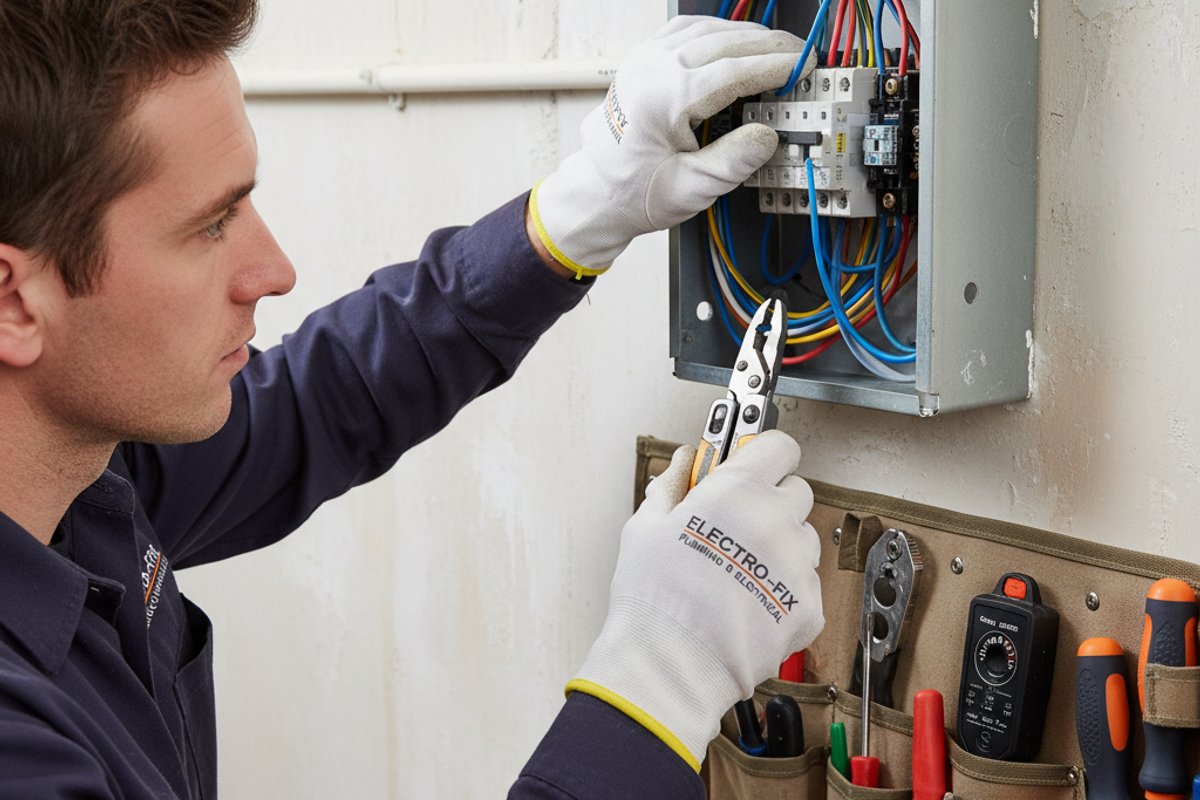
A consumer unit replacement is a single-day job for most Liverpool properties. The supply is off for most of the day while the work is carried out and tested. An EIC and Part P certificate are issued on completion. If you are unsure whether your existing board needs replacing or just repairing, a site survey with Michael takes about 30 minutes and results in a written, itemised recommendation, not a round number over the phone.
Why Maximec
NICEIC-registered and covered by the NICEIC Platinum Promise, which protects the work for up to six years if something goes wrong. Founder-led: Michael is the lead electrician on the majority of consumer unit and rewire jobs.
Based in Rainhill, we cover Liverpool and the wider North West, Aigburth, Woolton, Mossley Hill, Allerton, Wavertree, the Wirral, St Helens, Widnes, Runcorn, and Warrington.
Related Services
Whether you need a straightforward consumer unit upgrade or have a more complex installation with old wiring that needs addressing at the same time, the best starting point is a site survey. That gives you an accurate picture of what is actually needed, rather than a quote based on assumptions about a board no one has looked at.
Your consumer unit past its best?
A free site survey with Michael takes around 30 minutes and results in a written, itemised quote, not a round number over the phone. Consumer unit upgrades are typically completed in a single day, with an EIC and Part P certificate issued on completion.
NICEIC-registered and covered by the NICEIC Platinum Promise. Based in Rainhill; covering Liverpool and the North West. Call 0151 792 3243 or request a free no-obligation quote.
Frequently Asked Questions
Do I need RCBOs instead of RCDs in my consumer unit?
For new consumer unit installations, BS 7671:2018 Amendment 2 requires individual earth-fault protection per circuit, which in practice means RCBOs rather than a shared split-load RCD. If you are replacing an existing board, the replacement must comply with current regulations. Existing boards are not retroactively required to upgrade unless an inspection flags specific safety defects, though upgrading to an RCBO board is a significant improvement in protection and convenience.
What is a split-load consumer unit?
A split-load consumer unit has two sections protected by separate RCDs, typically one RCD covers lighting and one covers socket circuits. The advantage was that a fault on one section did not affect the other. The disadvantage is that one RCD covers multiple circuits, so a single fault can still take out several rooms at once. The RCBO board supersedes this design by giving each circuit its own individual protection.
Do I need a Surge Protection Device (SPD)?
Under BS 7671:2018 Amendment 2, an SPD is required for new consumer unit installations in most domestic properties in the UK. The requirement is based on a risk assessment under Regulation 443.4, in most standard residential properties, the risk of transient overvoltage from external sources (lightning, grid switching) is sufficient to trigger the requirement. Your installing electrician will confirm this as part of the design process. An installation without an SPD where one is required would be non-compliant.
How much does a consumer unit upgrade cost in Liverpool?
A straightforward consumer unit upgrade in a standard 3-4 bedroom Liverpool property typically costs between £400 and £800 including materials, labour, and the EIC/Part P certificate. The price varies with the number of circuits, whether the meter tails need upgrading (25mm tails are often needed in older properties), and whether any remedial work is required on existing circuits before the new board can be tested and certified. Maxim Electrical Contractors will give you a written itemised quote after a free site survey.
Does replacing a consumer unit require Building Control notification?
Yes. Consumer unit replacement is notifiable work under Part P of the Building Regulations. A Part P-registered electrician (such as NICEIC members) can self-certify the work without a separate Building Control inspection, they notify Building Control on your behalf as part of the job. The Part P certificate and EIC they issue are the proof that the work was carried out by a registered contractor and meets current regulations. Non-registered traders cannot self-certify this work.
How long does a consumer unit replacement take?
Most consumer unit replacements in standard 3-4 bedroom Liverpool properties take a full working day, typically 6 to 8 hours. The supply is off while the old board is removed, the new board is wired in, and all circuits are tested with a multifunction tester before the supply is restored. The EIC and Part P certificate are issued on the same day in most cases. You will need to be present or have someone available to give access.
Will my home insurance be affected by an old consumer unit?
Some home insurers ask whether your consumer unit has RCD protection and when it was last inspected. An older split-load board or a board in a plastic enclosure can trigger additional questions or higher premiums. A satisfactory EICR (Electrical Installation Condition Report) and an up-to-date consumer unit make the insurance conversation straightforward. Ask your insurer what they require if you are unsure.